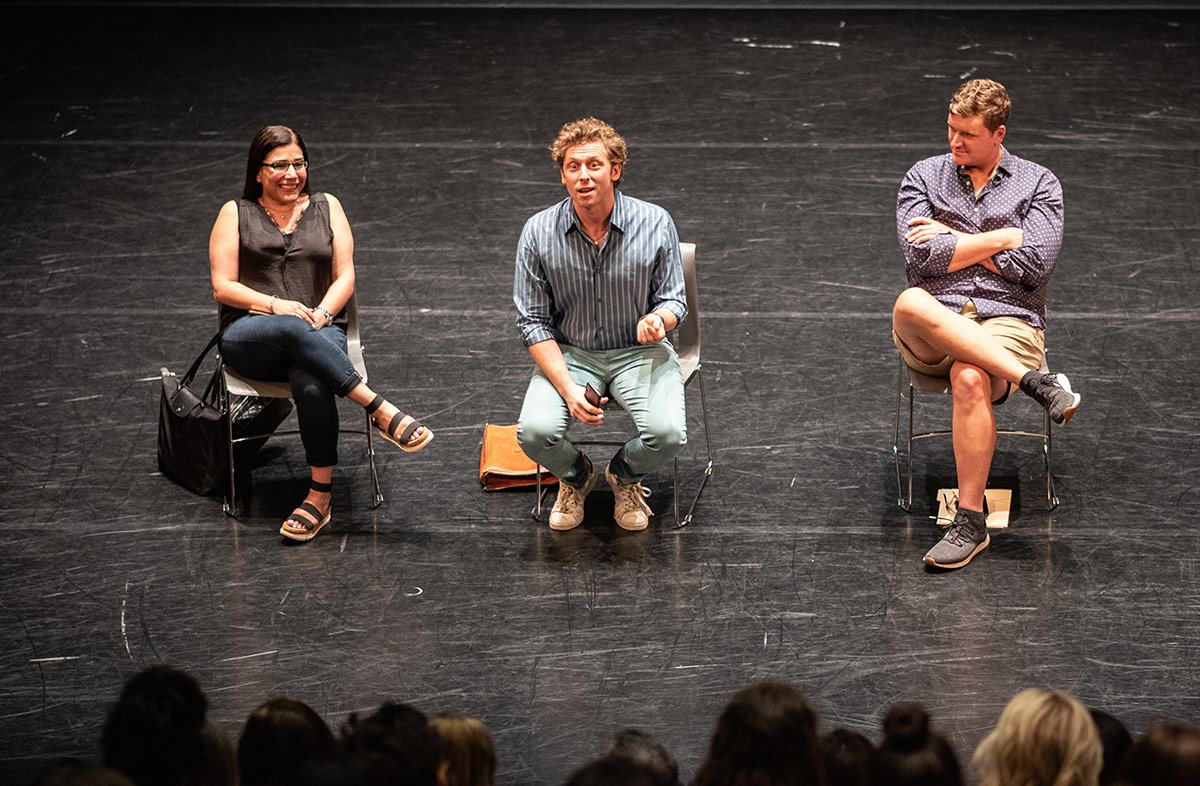
Wow, how is it October already? Time already for another MTCA Director-Blog from yours truly. This is one I’ve been teasing for awhile on the podcast, since I think it’s such an important mindset unlock for young actors, and it’s never been more relevant than it is to young people today.
SHARING yourself in the room, as opposed to HIDING
And that concept is the idea of SHARING yourself in the room, as opposed to HIDING. It’s very important in your live auditions, but also important think about at this time of year as you are filming and submitting your prescreens. What is that active process of SHARING yourself (of course choosing what feel like positive attributes that you WANT to share) rather than trying to hope the people behind the table don’t see your weakness or flaws.
You’ll often hear us talk about the idea that auditors aren’t looking for perfection, and that they are opposed to “shellacked” or “rigid” performances. This act of hiding can be big part of what leads to that shellacking – we often see young actors doing the equivalent of “look over here, not over here!” hoping we won’t find them out for what is missing in their audition package. The fear being if you relinquish control then you might be truly SEEN and be found lacking.
This is the most natural human instinct – it’s our defense mechanism to hide. It’s like an internal fight or flight where we are fleeing inside our own performances. If they just reject my PERFORMANCE then they won’t really be rejecting me, right? If I can just hide behind my tricks, I’ll be safe!
But if we’re worried about not making mistakes, not being found out, our auditions will end up feeling anodyne, safe, and ultimately forgettable. If the EVENT in the room is you meeting a college, and going on a very specific kind of speed date (which it is!), then you will have left the room having never really introduced your real self.
So what do we do instead? Our goal is to lean forward, and focus actively on sharing ourselves. The same way that when we feel a room rushing, we need to have that conscious counter-balancing effort that tells us to SLOW DOWN, when we feel that instinct to hide or protect ourselves or play if safe, we need to put the pedal to the medal and leap into sharing. The goal should be to leave every audition room smelling like all kinds of YOU (figuratively, not literally, of course). You want to have shared so much of you in that room that the next auditioner will have trouble clearing out the resonance of it.
You want to have shared so much of you in that room that the next auditioner will have trouble clearing out the resonance of it.
And finding that leaned-forward place can lead to all kind of great things – it leads to risk-taking, a sesne of fun, a sense of play, and even a bit of danger in the lack of control that you’ll have.
In the comedy world we often talk about the “speed-of–fun” – which is not about something just being fast – it means you’re letting something out of the tight grip of your control and challenging yourself to see what you can do when there’s a risk of failure.
This is true on camera and over zoom as well. There is an active skill of forcing your face and eyes to be viewable and letting the Camera take you in. That’s vulnerable-feeling when you do it on Zoom, but especially hard to do when you’re In-Person. To get to the place where you feel comfortable with being seen – truly being seen, by the people behind the table. Truly being seen means being seen warts and all – not just from the perfect instagram angle of yourself. To let them in with the oddness and quirkiness and messiness that might be you at 17 years old right now.
And as an Actor, I like to phrase it that way in “being seein” rather than “to SHOW them” – which can lead to you showing them a different kind of mask. As much as we don’t want to show them a mask of perfection, we also don’t want to shove a mask of false vulnerability in their face. To genuinely share yourself is in an allowing, not a forcing. This is really hard to do, especially when you’re nervous, but it is doable! It’s allowing your actual authentic light to shine rather than shoving in their face a certain kind of light you think they want to see.
It’s allowing your actual authentic light to shine rather than shoving in their face a certain kind of light you think they want to see.
We recently talked about this on the podcast with one of our MTCA Alums, Molly Griggs, who talked about being comfortable with the embarrassment of it all. That sometimes we’re sharing moments of people’s lives which are not camera-ready and easy to present. It takes a real comfort and confidence of an actor to be able to go to some of those vulnerable and embarrassing places – to explore things comedically and dramatically that don’t come up on an everyday Tuesday for most people, and certainly aren’t shared publically. To be able to be private in public is a difficult and beautiful thing.
For young auditioners, the SLATE can be a great opportunity to practice this idea of sharing your genuine self actively. Of course this is just one small part of the audition, but it’s a great example where so many of our students approach it like a beauty pageant – they’ve got to say exactly the right words and don’t-mess-up-the-playwright’s-name-or-forget-the-musical. (Which, sure, learn your playwright’s name and the piece your song is from). But in actuailty, that’s just not the right focus. If you’re worried about getting it “right” then that’s the event of your slate, and we miss the introduction. Instead of getting to share this incredibly important information of WHO you are, and WHAT you’ve picked out of the entire canon of monologues and songs to show me who you are!! In that moment, I’m not just learning about the choices you’ve made, I’m learning about YOU the actor in your POV of the Material you’ve hopefully joyfully selected with conscientiousness. Let that slate moment be an opportunity. Let it be loose and playful and YOU. Let it be interactive! If they comment on a piece they are excited to see, let yourself be able to listen to their reaction, and respond. Now you’re showing them YOU the student-actor in a real moment. I’m not against slates that are creative if that feels like you, but they also don’t have to be overly innovative – the simple script can remain the same or similar to what everyone says – it’s about going beyond the script and what you bring to it. Even the phrase “I’m Charlie Murphy” can be radically different if I’m pronouncing information versus sharing myself with people behind the table. [And while we’re on slates, please don’t forget to take that time between your slate and beginning your pieces – if you’re going to go to some of those vulnerable places in your material, take the time you need to do that great work you’ve been practicing in your bedroom! If you’ve been working with coaches on a Moment Before and Objectives and Obstacles and all of that great stuff, it’s all for naught if you forget to actually bring that work into the room with you!]
When you think about Slates, and really all of the aspects of an audition, they really are ALL opportunities to learn about who you are.
When you think about Slates, and really all of the aspects of an audition, they really are ALL opportunities to learn about who you are. When I’m debriefing Mock auditions with our students, I often talk about what the criteria they might use to select a class based on what they say today. I invite students to think like faculty members and imagine themselves putting together a class of people they would want to work with for four years, that they would want to train. Of course talent is going to be a large factor in those decisions, and the work done in material itself – but I invite them to actually think through how much is shared from the moment you walk in the room, from your Intro to your Slate, to the way you talk to an Accompanist, to the way you Prepare yourself to do your work, in your Transitions between pieces, How you Answer Interview questions, How you Take Adjustments, What Questions you Ask, How you Leave the Room. All of those things which have nothing to do with your Songs and Monologues. And they are all opportunities to SHARE. As of course is the material selection (which we’ve talked about previously) and the work itself that you do, that you want to be sharing and letting yourself be taken in. But if you think on the faculty end, what are those final factors, I promise you it’s not just the 20 most talented students numerically who get into each school. There are so many factors in what can lead to an acceptance, and it’s not just how loud you can belt and if you can kick your face. And I think when students think through that having just met actual other human beings, that feel patently obvious, but it’s not always how they think walking in. They think for THEM it will be a question of whether they nail the high note or whether they crack – or whether their comedic monologue gets a laugh or not. But when they are looking at others they can see how charmed they were by a simple and honest interview answer, by the way someone gamely navigated a tough adjustment, or dealt with a flub in their monologue.
And if you think from this perspective, in the way colleges are evaluating those factors, I would care much more about adding positive points to my ledger than trying to cover up any flaws. We tend to focus on our own small mistakes, whereas others remember the positives. Think about your experience of a time when you were nervous about someone staring at your pimple, but all they remember is your kind smile. That is almost the one sentence version of this blog– don’t be so worried about your artistic pimples that you get too self-conscious for us to see your genuine smile.
And that’s not say that colleges won’t care at all about potential flaws. Red Flags like an attitude problem, or being difficult to work with could certainly count against you. As could certain vocal, physical, or musical issues. [Though, as we’ve talked about before when it comes to attitude, the vast majority of students today do not have attitude issues when it comes to cockiness or defensivenss. More young students walk in with too much timidity, for fear of not seeming humble, and that leads to too much meekness].
Worry less about the possibility of a vocal crack, a line messed up, or whatever artistic flaw you are trying to hide from them, and worry more about the shot not taken.
So my big advice for you?
Worry less about the possibility of a vocal crack, a line messed up, or whatever artistic flaw you are trying to hide from them, and worry more about the shot not taken. Worry about the audition where you didn’t give it your 10-out-of-10 for fear of failure, and so you achieved a safe 6. Since I can’t help but make a baseball analogy in basically all of these blogs, try to Swing for the Fences and let them see a really long foul ball (or even a giant swing and a miss!) rather than a timid bunt down the 3rd base line. As an educator, I can work with a big swing and a miss where you end up smiling on your butt a lot more than I can someone who leaves the bat on their shoulder.
So share yourself, shoot your shot, take down the mask, and get yourself fully in the game! I can’t promise it’ll be comfortable, but I promise with practice it’ll get easier. And it’ll help you reach your full potential as an auditioner for this process and beyond.
About The Author

Charlie is a native Pittsburgher and a proud graduate of Carnegie Mellon University, where he studied Acting. As an actor, Charlie has performed for the NY Public Theatre’s “Shakespeare in the Park” (All’s Well That Ends Well, Measure for Measure), the Pearl Theatre Company (Richard II), the Hudson Valley Shakespeare Festival (King Lear, The Three Musketeers, Romeo and Juliet, Love’s Labour’s Lost), The Shakespeare Theatre of DC (Richard II, Henry V, As You Like It, Mrs. Warren’s Profession), Middlebury Actor’s Workshop (Cat on a Hot Tin Roof), The Arts Center of Coastal Carolina (The Unexpected Guest), and the Chautauqua Theatre Company (Much Ado About Nothing, Vaidehi, Ah, Wilderness!). Along with MTCA coaches Ryan Quinn and Katie Hartke, Charlie co-founded and is the Managing Director of Esperance Theater Company — a company that produces classical-based work here in NYC. With Esperance, Charlie has performed in 12th Night, Macbeth, Romeo and Juliet, and Breitwisch Farm. As a teacher, Charlie has been working with MTCA for over 17 years, where he is now a Director of the company along with Leo Ash Evens. Charlie also teaches Acting and College Audition Prep for the Performing Arts Project (TPAP), where he is on faculty each summer. He has also taught for Texas State University, the City University of New York, and the Hudson Valley Shakespeare Festival. As a Teacher and Director, he is able to do two of his favorite things in life: help students to find their authentic selves as artists, and help them find their best fit for their collegiate journey. Charlie also hosts the “Mapping The College Audition” podcast, where he continues that work, and helps demystify this daunting audition process. Charlie is also the proud father to a precocious toddler, partner to an amazing Tony-nominated + Grammy-winning Actress, and a humble Broadway Softball League champion.