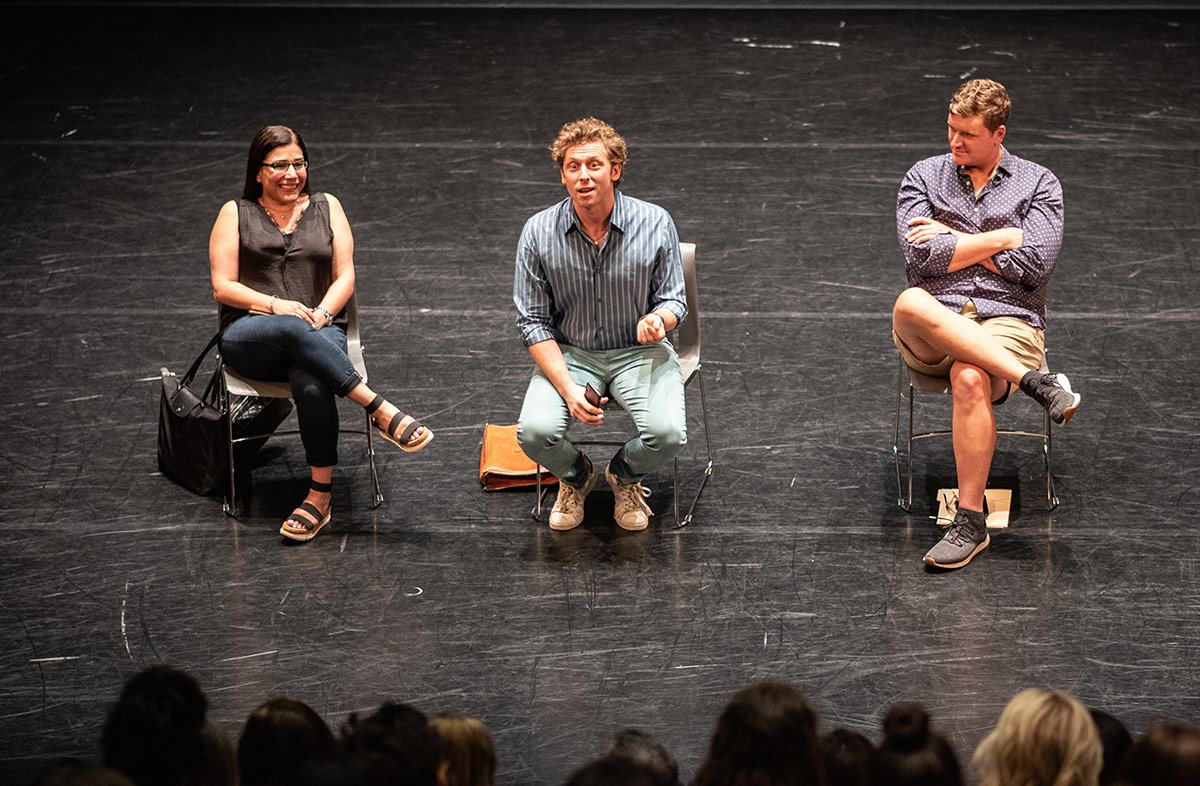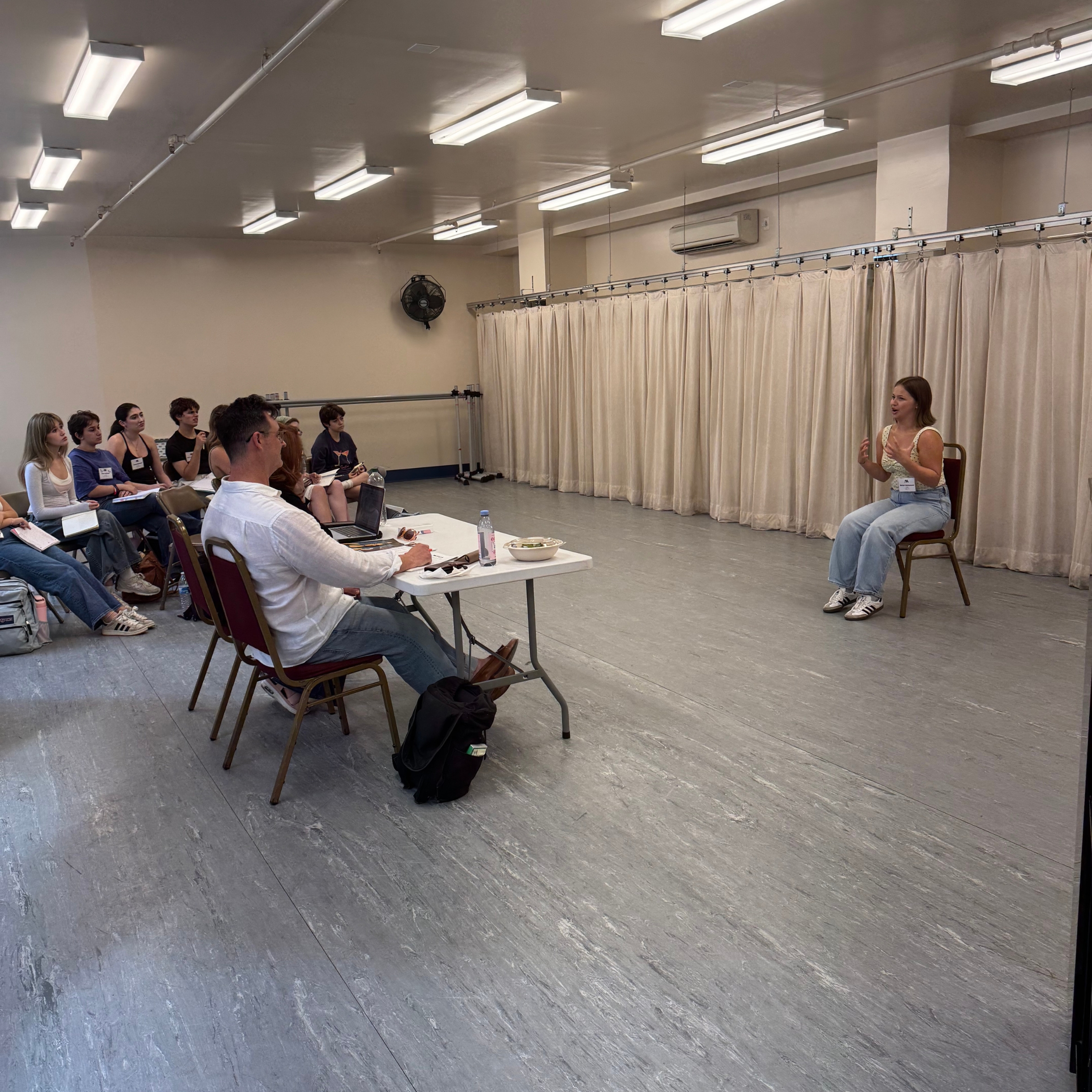
Hey y’all, Happy August! I was delighted to see many of you at our recent Summer College Faculty Masterclass Week, where you got to explore the very topic of this blog in front of some amazing educators from some of the most competitive colleges in the country. And that question is: what is the right balance between preparation and presence? Or put another way, how do I successfully prepare my audition so that it doesn’t feel like a “performance”, but instead a successful showcase of where I am right now as a student in process?
I’ve had this topic down to write about for a while since the idea came up on a podcast with Matt Rodin, where he challenged young artists to see how “close to the impulse for an idea the speech can happen”. He was talking about both performances and social media – challenging young people not to overly craft or self-direct, but to let their impulses lead them authentically.
it’s not just practice that makes perfect, but perfect practice
I think that’s a great place to start this exploration on the theme, since I am going to posit that the “sweet spot” between preparation and presence is not so much about HOW MUCH you prepare, but about HOW you prepare. Like Vince Lombardi will tell you, and you’ve read before on this blog, it’s not just practice that makes perfect, but perfect practice. And as you all know, the goal in the artistic process is not perfection. I’m not sure how many P words I should try to string together here (“productive practice can progress toward presence?”), but what you’re striving for in the artistic process is a combination of technical improvement while maintaining some of that original impulse that will make the work feel organic and authentic. Like so many things, the tension between those two ideas is what makes the work exciting. When we see great performers on stage, it seems like they are saying words for the first time as if they’ve just discovered them, even if we intellectually understand that this is their 7th show this week and they’ve been performing it for a year.
And I’ll say, while there can be tension between these two concepts, they are not antithetical to each other. You really can have both. In fact, I think it’s often difficult for an artist reading (or singing) words for the first time to make them sound organic and truthful. Especially for young artists, before they’ve honed the skill of cold reading, there will be an inauthenticity merely to the fact that they are reading and translating the work of a playwright/composer into their own voice. This same issue will happen to a young auditioner who is trying to audition “off-book” when their lines are only partially memorized. No matter how organic their impulses might be, and how talented an actor they may be, there can be a specific kind of inauthenticity that involves the search for lines that are just out of reach, which feels different than a human being creating speech. But the reason so many young artists will lean in this direction is because they have a fear of “over-preparation”. They may have experienced a show that became stale from what was a perceived over-rehearsing or a long run, or experienced a monologue or song that was over-directed and choreographed within an inch of its life, and that led to a robotic feeling devoid of organic impulse.
I could find my way through the piece because I knew where I was going, even if you turned off the lights or dropped me in a different part of the map, I could still get there
What I will say is that I don’t believe you have to choose between these two extremes. In my experience as a performer and auditioner, the times I felt most robotic were when I was only slightly prepared (and often hastily so), which made me cling tightly to that scant preparation out of anxiety. Now I become a tyrannical director to myself, over-rehearsing and gripping too tightly, and my instrument isn’t open to the experience of the audition. And that has cascading negative effects, now my nerves are getting in my way because I’m gripping too tightly, and it’s all downhill from there. And I will say, there is a particular thrill to the seat-of-your-pants kind of experience as an auditioner – especially when it’s something that is thrown to you as a “cold read” or an adjustment where preparation wasn’t possible. But my very best experiences in both the audition room and on stage came from a very different place. They came from a place where I was SO prepared that I didn’t have to think about how prepared I was. When I knew a piece well enough that I could say it while I was doing Jumping Jacks or with a French Accent. That I knew all of the words I was saying backward and forwards, but also the impulses behind those words, and I had explored why one thought may have led to another in a hundred different ways, so that I didn’t only have one path to get there. In those situations I was able to confidently take a direction in the room, because a new impulse wouldn’t throw me off – I could find my way through the piece because I knew where I was going, even if you turned off the lights or dropped me in a different part of the map, I could still get there. Too often young students learn their pieces in a way that A leads to B leads to C – but that means if a curveball is thrown their way, they feel lost. If asked to give a different line-reading, they will lose the words that come next.
This, I think is the key to being truly prepared in a way that invites presence. If you adjust the way you prepare so that you aren’t just grooving yourself further into the rut of a singular performance, but exploring a range of different possible performances. This doesn’t mean that you’re doing it completely at random – in the work you are doing you will likely start honing in on a range of performance options that may get tighter over time. But you never need to tighten the rope so far that it restricts the blood flow of new impulses and possibilities. Because we as artists aren’t working toward nailing the perfect line readings. And certainly in the college process there’s no “right” way to say the words or sing the songs that will magically get you into school. You’re not showcasing the piece or performance itself, but you the performer, and part of what you’re showcasing in showing off your ability is your aliveness and flexibility. These schools don’t want to accept perfect 18-year olds exactly as they are and then send them off into the world four years later to accept their plaudits. They are hoping to find talented young people who they can nurture and help for four years to become the best artists they can be.
the most important thing a young actor can do is to dig deep into their technical, foundational work
And I will note that for some young artists, especially in the musical theater, one of the obstacles to showcasing their artistry may be technique. If you are struggling to sing healthily, or to sing the right notes, it is very difficult to show your skill as an actor while singing. If you can’t remember the dance steps, or keep tripping over your two left feet (guilty!), it can be difficult to show what a strong actor you are while dancing. So at some points of the process, the most important thing a young actor can do is to dig deep into their technical, foundational work. But as you’re doing this, it shouldn’t be at the expense of your freedom and impulse – if anything, think of that foundational work as the thing that will GIVE you that freedom in the future. Only after you have confident vocal technique can you really open up and just communicate as a singer. Only after you know the steps can you really dance. And only after you really know the words that you are saying to the point that you don’t have to think about them can you now work to discover them as if you’ve never said them before. I won’t say those are all hard and fast rules, but I do think that is true for most young artists that they are able to find more freedom when they are better prepared with a foundation of technique.
Your expert preparation can lead to increased sensitivity to these factors, and a more present and alive audition, if you let it!
I’ll wrap with a physical analogy that I’ve always found helpful. Maybe it’s from my days playing baseball as a kid where they would teach the “ready position”, which meant you were ready for the ball to be hit in any direction and you would be able to react to it. Maybe that’s why I always think of presence as living in the balls of my feet. But any time I am trying to bring myself into the moment, before an audition, if I’m feeling like I’m getting in my head, I do a few calf raises and lean forward just to feel the balls of my feet. This gives me the impression that I am “ready for anything”, which is the right idea. I’m ready to do this monologue or sing this song in a way I’ve never done it before. In the same way that it’s impossible to field a ground ball in exactly the same way because no two balls will bounce in the exact same way. But having fielded those ground balls 1,000 times before will only make you more confident and more able to field the next one, and to react to the surprising hop when it comes. The practice in that case will have allowed you to be more present to all of the surprising possibilities that could happen. Whereas if you’ve only fielded 5 ground balls and they’ve never taken a bad hop before, you wouldn’t want that first “bad hop” to happen in an audition room. In that same way, those actors who have “over-prepared” and grooved themselves into a rut have given themselves boring and predictable hops. They are not allowing their body to have the freedom to react to what is new in an audition room: be that their reader, their accompanist, the room tone, whatever it is. Your expert preparation can lead to increased sensitivity to these factors, and a more present and alive audition, if you let it! You may never find a singular “sweet spot” where you always feel completely alive and in the moment, but you can keep working actively toward becoming more present and in your body, listening to your auditors and yourself, and you will only continue to have better and better auditions as you do.
About the Author
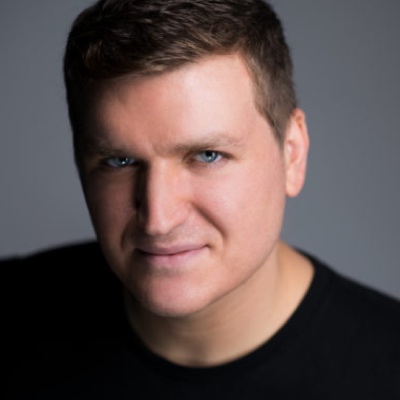
Charlie is a native Pittsburgher and a proud graduate of Carnegie Mellon University, where he studied Acting. As an actor, select stage credits include the NY Public Theatre’s “Shakespeare in the Park” (All’s Well That Ends Well, Measure for Measure), the Pearl Theatre Company (Richard II), the Hudson Valley Shakespeare Festival (King Lear, The Three Musketeers, Romeo and Juliet, Love’s Labour’s Lost), The Shakespeare Theatre of DC (Richard II, Henry V, As You Like It, Mrs. Warren’s Profession), Middlebury Actor’s Workshop (Cat on a Hot Tin Roof), The Arts Center of Coastal Carolina (The Unexpected Guest), and Chautauqua Theatre Company (Much Ado About Nothing, Vaidehi, Ah, Wilderness!).
In 2015, Charlie co-founded Esperance Theater Company — a company that produced classical-based work here in NYC. With Esperance, Charlie produced and performed in 12th Night, Macbeth, Romeo and Juliet, and Breitwisch Farm. As a teacher, Charlie has been working with MTCA for over 20 years, where he is now a Director of the company alongside Leo Ash Evens. Charlie has also taught for Texas State University, PACE University, The Performing Arts Project (TPAP), Broadway Dreams, the City University of New York, Carnegie Mellon’s Pre-College program, and the Hudson Valley Shakespeare Festival. As a Teacher and Director, he is able to do two of his favorite things in life: help students to find their authentic selves as artists, and help them find their best fit in their collegiate journey. Charlie also hosts the “Mapping The College Audition” podcast, where he continues that work, and helps demystify this daunting audition process for listeners around the world.
Charlie is also the proud father to a precocious toddler, partner to an amazing Tony-nominated + Grammy-winning Actress, and a humble Broadway Show League Softball MVP.